
Different study patterns for equine massage
In this article I discuss various training options in equine massage. I’m looking at this because trying to find a way of learning which suits you, particularly if you are a mature student or trying to fit your training around another job, can be difficult.
I will broadly cover the various patterns of delivery of courses which are available if you search “training in equine massage” on Google. However, I strongly recommend, before you start, that you read the “Courses vs Qualifications” article.
You should be clear before you make a decision that the training course you are about to undertake will give you the outcome you hope for in terms of acceptable level of accreditation or qualification. In other words, will the course you choose enable you to work in the future in the way that you wish?
And obviously, I am going to advise according to my own opinions – yours may differ!!! – and everyone has life situations which mean their priorities will be different too.
Helen Tompkins
ATSL
Online vs In-person
A&P:
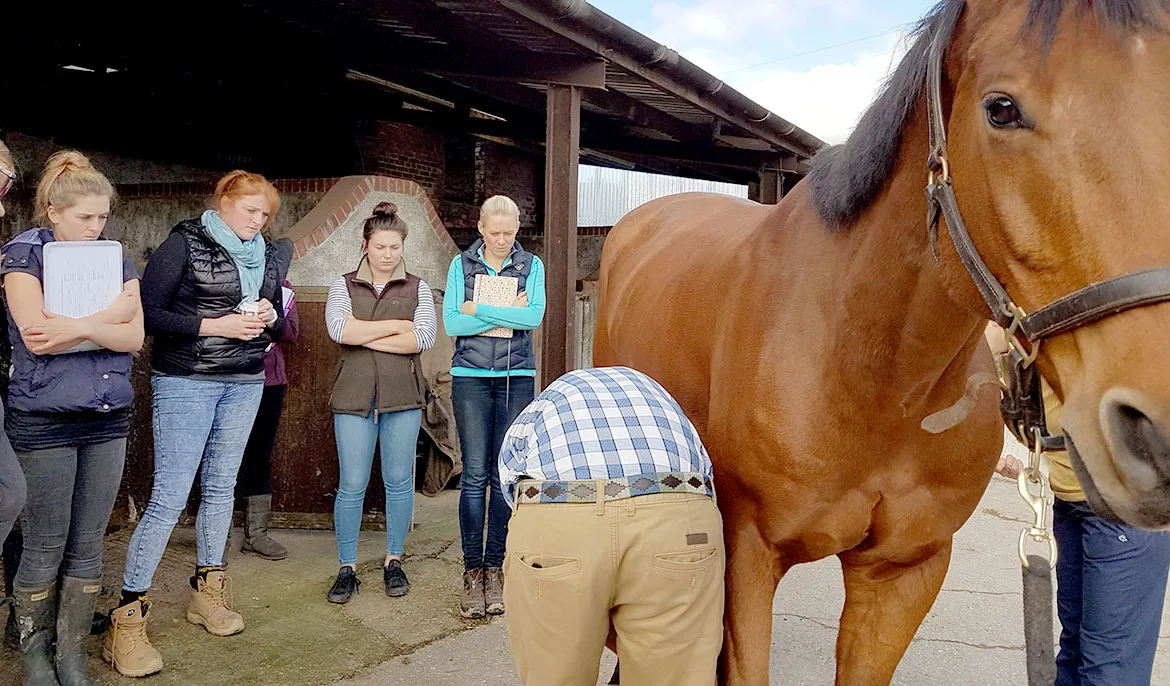
It is of course possible to undertake anatomy and physiology study online; the materials and course booklets or videos can be watched at the learner’s leisure. However it is also true that anatomy can be very hard to get “off the page” – ie it can be difficult to relate the knowledge in the book to a live animal, and it is essential that you can do this. So whilst A&P can be done online, if you are a visual or tactile learner, consider whether you would actually find learning the information easier if you could pick up a bone and physically place it against the horse… or whether learning muscles would be easier for you if you could actually put your hands on the right area of the body and feel the structure underneath with someone helping you to know you are in the right place.
Massage:
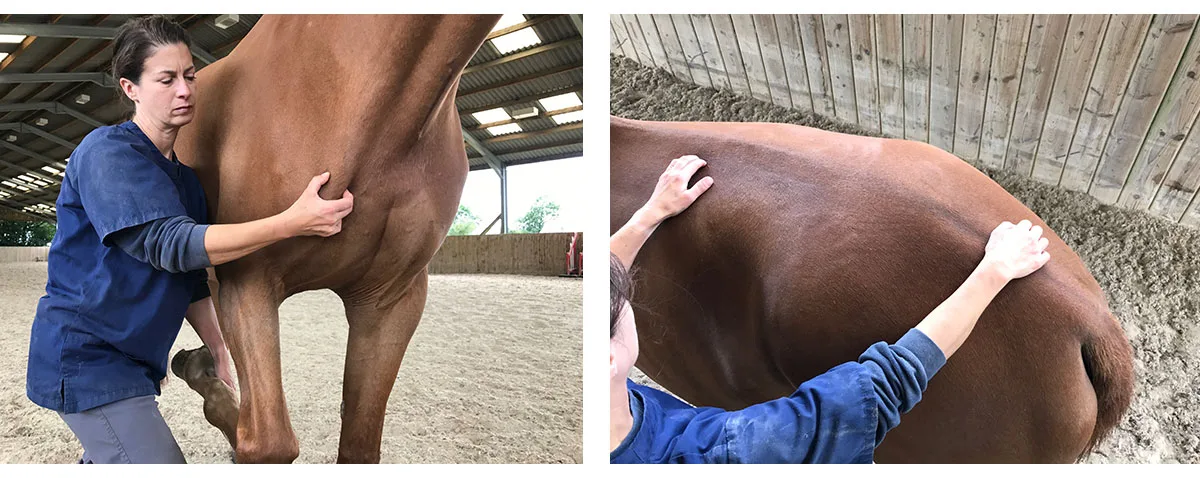
We at ATSL believe that massage can not be properly taught or learned online. We also actually encourage our students to have some human massage experience before they work on horses. This is not a legal requirement, we build it in to our Level 4 course in order to ensure that our students have a base level of manual skill, are familiar with the massage strokes and know what they feel like to receive before applying them to a non-verbal patient which cannot give feedback. Even if the course you are looking at doesn’t incorporate this, you should probably make sure that the manual training is face to face. Only then can your trainer make sure your position, depth, rhythm and stroke technique is correct.
If you also hold a human massage qualification, then obviously you will be able to also work on the rider. Knowledge of how the rider affects the horse and vice versa can make significant differences to the performance of the horse/rider team – at all levels from hackers to serious competitors and from Trek to Eventing.
Intensive/short term vs long term study
Practical skills
It can seem attractive to do an online theory course with an intensive period of in-person massage training. However, most courses (at least the ones which are in any way reputable) will ask you to do case studies to support your learning; this will involve working on a number of horses over a number of weeks.
The problem with undertaking an intensive course of practical study is that you may be given all your manual skills at once, and then asked to go and practise them. There will, however much you try to avoid it, be slight changes in your technique and slippage away from they correct manner of performing strokes. Because your patient will be a non-verbal animal, the patient cannot tell you that you have changed your hand pressure, strength, rhythm or tone. There is a real possibility that you will develop habits which mean your technique becomes less effective and the lack of ongoing monitoring can mean that you embed the incorrect technique in your muscle memory.
A better way of learning is to ensure that you will have supervision along the way from a tutor, or a mentor. You may even be given the techniques in bite-size chunks, allowing your hands to familiarise themselves with the feeling of the technique and learning how to adapt one particular skill to a variety of horses. A tutor may watch you work and move one of your fingers half an inch to the left – this tiny adjustment can make all the difference. The more supervision you have, the better and more precise your manual skills will come. And from this embedded knowledge will come intuitive touch as you begin to make the small adjustments yourself.
Theory
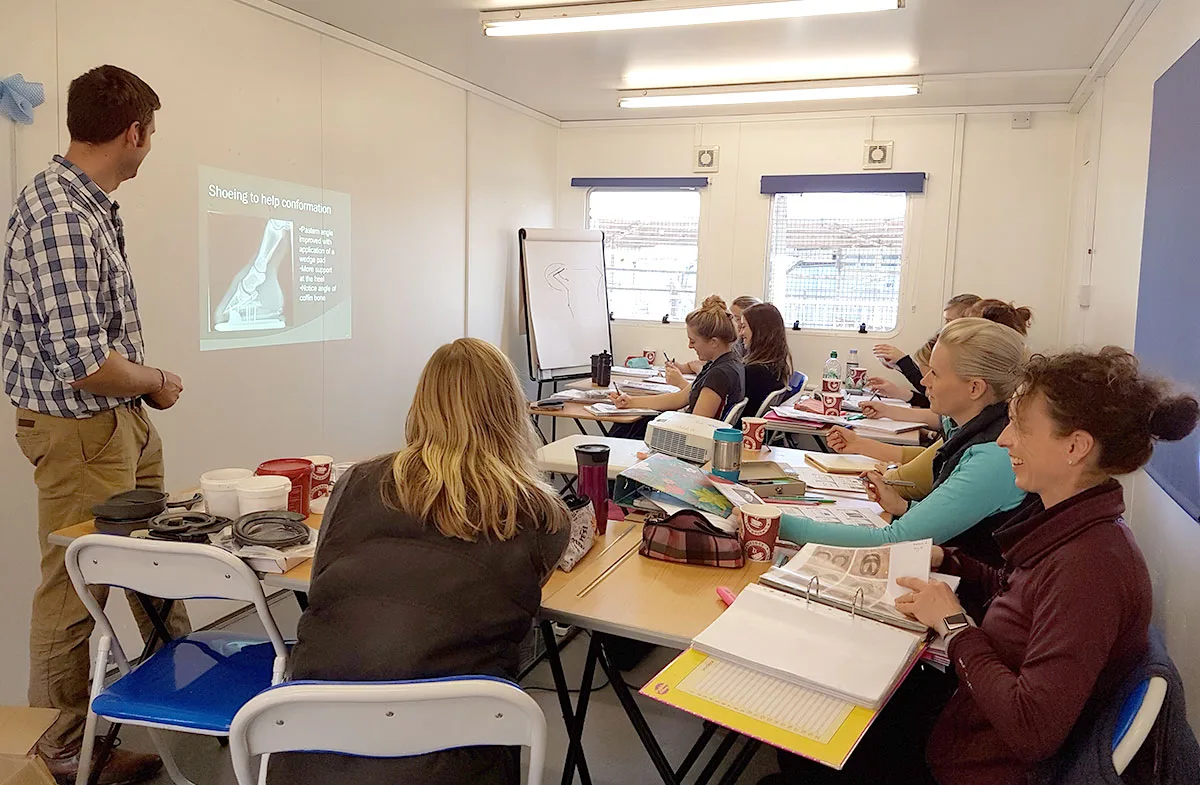
If you are very good at assimilating a large amount of knowledge in a very short period of time, then maybe an intensive course will suit you. If you need longer to make sure that you have understood the knowledge to the point when you can apply it to a real life situation, perhaps a longer term delivery would be better for you. The anatomy is key to underpinning all your treatment decisions, so it is something that must be very clearly understood. At ATSL we also cover farriery, saddlery, different equestrian disciplines, ailments and veterinary treatments, and stable management in some detail, so all of this must become second nature too. It is a huge amount of work to cover and trying to learn everything in a short space of time is very difficult.
Studying alone or with a cohort
Many of the options for training make much of the students’ ability to “study at their own pace” or work their learning in to their life pattern. For some people this works. However, in order to become a professional therapist, there is a huge amount of knowledge required (see “theory” above). Sometimes students working alone lose their motivation and let the work slip, or have no one to discuss things with when the work seems difficult. It is often better to enrol on a programme of study where students work through the modules together, so they can encourage each other and be able to discuss the work so that depth of understanding is increased. Peer pressure can also help with time management; everyone wants to move forward together so members of a group motivate each other.
In addition; within a cohort there are always people with very different life experiences. Group discussions can help deepen knowledge and understanding; a dressage horse is not managed or trained in the same way that a race horse is; and that will also differ for an endurance horse or polo pony. So being able to share and compare knowledge is a really good way of deepening your understanding of disciplines that you might encounter in out in practice but have no knowledge of in real terms. You will gain respect from your clients if you understand their world; and the advice you can give will be far more relevant.
Student Insurance
Any course which requires the students to work on horses which are not their own (and all reputable courses should do this) should require the students to obtain student insurance. This will cover the student for any problems occasioned during the period that the student is not fully certificated. This is extremely important. Massage can cause problems when performed incorrectly and students must be insured. So you need to check that the course you are looking at will entitle you to student insurance.
Assessment
Some courses – even accredited courses (which are not qualifications) will use internal assessment by the course tutors for final assessments.
I believe that a professional exam in equine sports massage should be assessed externally by expert professionals in the field; such as vets and physiotherapists. Only then can the student be certain that the standard they have reached is truly going to be recognised in industry.
What is your long term aim??
If you are hoping to become a professional therapist working on horses, and make your living this way, you should aim to become fully qualified in the role.
This means you will need to undertake a course of study which is a formal, regulated qualification, not just an accredited course.
Look at the “Course vs Quals” blog article make sure you understand the difference. You will need a qualification which is professionally recognised within the industry and also recognised by the Therapists’ Registers as preferred by the RCVS and DEFRA. Registration with either RAMP or AHPR will be essential going forward. These registers only accept regulated qualifications. So if you want this to be your new career, make sure the course you take meets the requirements of the Register you should be aiming to join, or your training will be of no value.
Which course do I recommend?
Well obviously, it’s the one we run – the Level 4 Diploma in Equine Sports Massage delivered by Animal Therapy Solutions Ltd
Pros:
- OFQUAL Regulated Qualification at Level 4
- Accredited by AHPR
- Recognised by RAMP
- Confers entitlement to membership of the Equine Sports Massage Association
- Single intake per year – so students work through as a cohort on a long term study programme
- Case study support
- Mentoring programme in place
- Face to face tuition for theory and practical
- External expert lecturers
- Insurance available
- Will produce excellent, industry recognised and competent therapists
- Externally assessed
- Industry recognised – this qualification has existed for many years
Cons:
- It’s hard!!
- It requires dedication, good time management and determination
- In-person attendance required on specific dates at a single location, which may mean some logistical challenges need to be met
Please feel free to message me or call 07970 619906 for a chat if you wish to discuss your options.


